

Q: What is the starting pay?
A: $18.93 per hour for Inside, 45% of Journeyman rate; $19.64 per hour for Telecom, 70% of Journeyman rate; $19.22 per hour for Residential, 60% of Journeyman rate
Q: How often do apprentices receive raises?
A: Raises are on a time and class-based schedule as per the Collective Bargaining Agreement. There are two in the first year and one every year after that. Since their wage is a percentage of the journeyman rate, any contract raises are proportionally paid to apprentices.
Q: Are there benefits? If so, at what point?
A: After working 140 hours and the associated paper work is complete, you and your dependents will receive health care coverage. It may take several months to qualify for benefits depending on hours worked. Pension and Annuity benefits are available starting in your second year. Upon being accepted into apprenticeship, new apprentices become members of IBEW Local 540 .
Q: Can I get credit for previous electrical training?
A: Credit can be given for “electrical construction” experience and related training. In situations where an individual’s prior electrical training cannot be formally verified, a proficiency test may be used to assess their trade knowledge and determine appropriate placement within the program. Military Veterans can also get credit for an M.O.S. that directly relates to Electrical Construction.
Q: What is the difference between the Residential, Telecom, and Inside Apprenticeships?
A: Residential work is in homes and apartments typically using nonmetallic sheathed cable. Telecommunications work is on low voltage systems used in buildings, such as, voice and data networks. Inside work is on the wiring and mechanical systems used to provide power to commercial and industrial buildings. All of the above apprenticeships require mechanical ability to install electrical equipment. Please click on the “Apprenticeships” tab at the top of the page to see more info about each program.
Q: How stable is employment?
A: Apprentices are assigned to signatory employers. There may be times during the apprenticeship when apprentices miss work. Factors such as the economy and weather influence job opportunities. The JATC attempts to keep all apprentices working continuously throughout their training.
Q: Is there an age limit?
A: No.
Q: Can anyone apply?
A: Yes, for more information on the application process please click on the following link: Info for apprenticeship
Q: Can I be admitted into the program while I’m enrolled in an Algebra course?
A: You are not eligible to be accepted into our program until you have successfully completed a High School or College Algebra Course with a passing score for any of our programs.
Q: How many apprentices are selected each year?
A: The number selected depends on demand and attrition of the workforce.
Q: What does the aptitude test consist of?
A: The aptitude test consists of 5 sections: Mechanical Reasoning, Numerical Computation, Numerical Reasoning, Paper Folding, and Reading
Q: Are there any ways to prepare for the aptitude test?
A: Yes. The test publisher sells an official study guide for $20 — that’s the most reliable way to know what to expect. Here is a link: “Study Guide“. You can also strengthen the underlying skills for free: basic math (fractions, percentages), spatial reasoning (try folding paper and predicting hole-punch patterns), and reading comprehension. Be wary of sites claiming to have “real” or “leaked” test questions — the test is secured, and no legitimate source offers that.
Q: Does any one part of the application process weigh any heavier than the others?
A: Some factors that are considered are academic ability, physical capability, and experience. We try to match aptitudes and interests to those that will allow for success in the electrical industry. All parts carry weight towards the overall score.
Q: Who should the letters of reference be from?
A: Letters are HIGHLY recommended and will count in the final score of your application. You can submit up to three letters. Letters should come from people who can speak to your work ethic and reliability — such as contractors, employers, supervisors, teachers, union members, other trade workers, or community members you’ve worked with. However they should not be from Family members.
Q: Do I have to pay for my schooling?
A: There is an administration fee each year, for your first year the fee is $500 and then $1000 each year after that for each of the programs. You will also need a device capable of accessing the internet and running necessary programs, and internet access will be required for all apprentices.
Q: Do I have to currently be working in the electrical field?
A: No, Apprentices are trained with a combination of classroom instruction and on-the-job training. The JATC will assign you with a signatory contractor. No previous experience is required.
Q: If I am chosen when do I start to work?
A: Applicants are selected based on industry demand. Generally, apprentices are selected in May to begin work around the beginning of June.
Q: When do classes begin?
A: Classes typically begin in late August and are scheduled to conclude by June. Classes are held Monday and Wednesday or Tuesday and Thursday and some Saturdays. Evening classes begin at 5:00PM and end at 8:00 PM or 9:00 PM. Students are expected to attend all scheduled classes. Most classes are held at the Greater Stark County Electrical Trades Center.
Q: What happens if I fail my class?
A: You must maintain a 75% GPA. A passing score must be achieved in all courses. Apprentices that do not make reasonable progress are in danger of being terminated from the program.
Q: What type of work will I be doing?
A: Electrical Construction – this means installing the electrical systems and associated wiring of residential, commercial and industrial buildings. Climbing ladders, working on scaffolds, working on overhead steel structures (you must not be afraid of heights), excavations of trenches or ditches. You will be required to work indoors and outdoors in various environments.
Q: What is the Canton JATC’s privacy policy?
A: Please click on this link to view our current privacy policy: Privacy Policy
STUDENT FEEDBACK
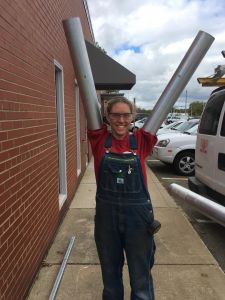
“After completing a few college courses, I realized the direction my career was headed was not what I had hoped. As my sights turned toward more hands-on work, the electrical trade offered diverse experiences and unique challenges. Under the guidance of journeyman on the jobs and teachers in the classroom, I developed more than just knowledge of the trade. I have built confidence, responsibility, a sense of pride in my work, and friendships that exemplify the brotherhood. From service calls to huge factory builds, the diversity of projects means there is always something to learn. Being an electrician is not easy, but it is rewarding.”

“Astrology class. That’s where I realized that college might not be for me minus the many assurances that teachers and guidance counselors told me that is where I belonged. Going to school for a history degree, I found myself sitting in an astrology class wondering what astrology had anything to do with history. I changed my major and did graduate, even worked in my field with my degree. However that degree did not ensure job security with my employers restructuring. I decided to make another career change and finally found myself in the electrician field I often thought about joining before college. After working non union for a few years, I am now a fourth year inside wireman apprentice at Local 540. I no longer find myself staring off to space wondering if I made the right decision as I sit in class learning valuable information that will translate out in the electrical field. I get to see and work on past history from the turn of the 20 century to the most state of the art that technology has to offer when it comes to electricity. I get to see projects come to life right in front of me from start to finish, day by day. Its a rewarding feeling building projects that will stand the test of time until the time comes for the next generation of electricians to come and maintain projects from decades before them.”

“I came to a point in life where I realized that I needed to make a career choice and not just another job. I was working retail with very little benefits and it made me think more about my future and what I wanted to do with my life. I wanted to work for a company where the opportunities for learning and growth within were endless. I had someone tell me that a trade can never be taken away from you, that once you learn it, you will always have it. I began looking into the electrical field because electricity has always fascinated me. I found the JATC and began to talk to people that have already gone through and realized that even if I knew nothing about the electrical field, I could learn with the help of their apprenticeship.
I have now been in the electrical field for 6 months and I am a first-year apprentice. The amount of knowledge I have gained between the school and actual on the job training they put you through is tremendous. I have enjoyed working in the field with many other electricians and being a part of a team that has an end goal, a vision of what needs to be done. It is a great feeling to step away from a job and being able to look at the work you have done.”

“I am currently a first year teledata apprentice. After graduating high school I knew I wanted to to go into the electrical field. I have always thought that kind of work would be interesting. As i heard more and more about the great opportunities the IBEW and JATC have to offer, I knew an apprenticeship would be the best way to start a career. Things I took into consideration before applying were pay, benefits, retirement, and talking to a couple Local 540 workers to see how they like the trade. Everything looked very good. So as far as an apprentice I have gotten to work on big jobs like a high school being built, and small jobs that take a day to finish. It is good seeing a variety of different things out in the field. You get to learn so many things. I would definitely recommend this opportunity to anyone interested in the trade and wants a good career.”